

If you’re searching for practical ways to bring more calm and structure into your home, you’re likely feeling the weight of missed appointments, overlapping activities, and daily routines that never quite run smoothly. This article is designed to help you take control through simple, realistic strategies for family calendar organization that actually work in busy households.
We’ll walk through how to streamline schedules, coordinate school and activity commitments, and create planning systems that reduce stress instead of adding to it. From daily routines to long-term planning, you’ll find actionable tips you can implement right away.
Our guidance is grounded in real-life parenting experience, child development research, and proven planning methods that support both parents and children. The goal isn’t perfection — it’s creating a home rhythm that feels manageable, predictable, and supportive for the whole family.
From Family Chaos to Calendar Calm
If you’ve ever double-booked a dentist appointment and a soccer game (and realized it in the car), you’re not alone. Parenting often feels like managing a tiny corporation without a central database. The real problem isn’t busyness—it’s the mental load: the invisible task of remembering everything for everyone. Without one reliable hub, details slip through the cracks.
This guide solves that. You’ll learn step-by-step how to build a shared system for family calendar organization that keeps school events, playdates, and appointments in one place—reducing stress, missed moments, and that constant “What am I forgetting?” feeling.
Choosing Your Family’s Digital Command Center
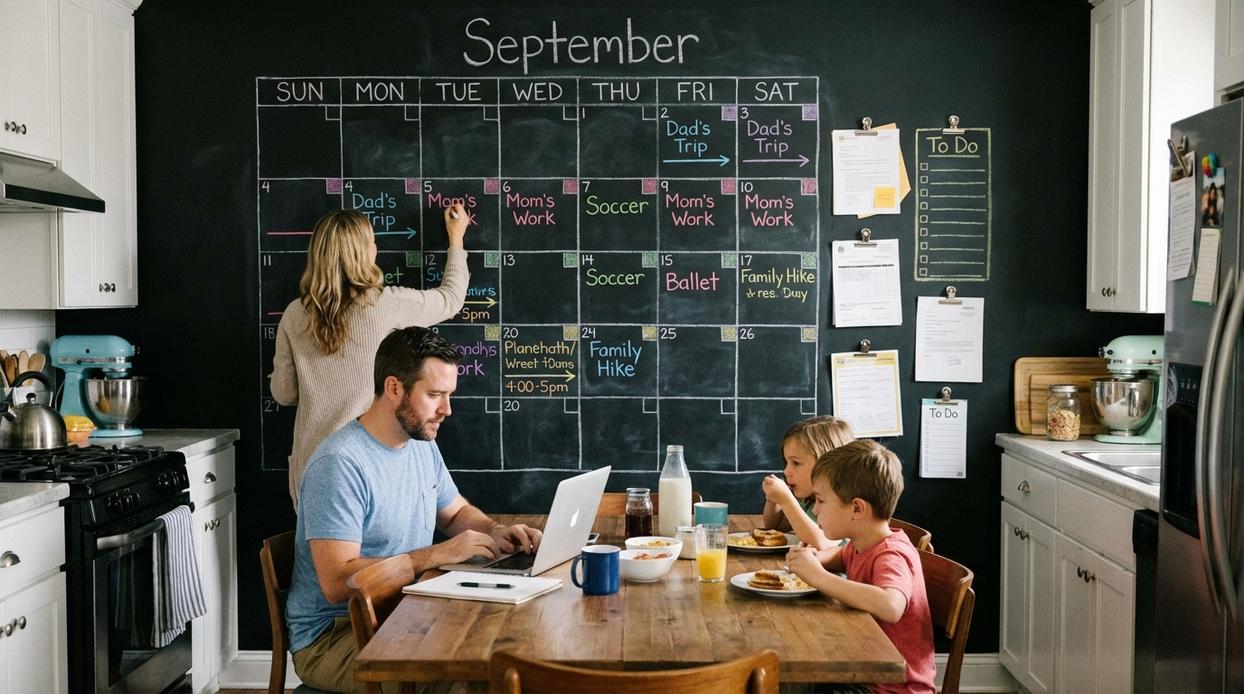
For years, the paper calendar reigned supreme on the kitchen wall. Some parents still swear by it. They argue it’s simple, visible, and doesn’t require Wi‑Fi (fair point). However, modern family life rarely happens in one room. Between work, school pickups, sports practice, and pediatric appointments, schedules move with you.
That’s where a digital calendar shines. First, accessibility matters. A cloud-based calendar (meaning it syncs across devices through the internet) lets everyone check updates from anywhere. Second, automated reminders reduce mental load. According to the American Psychological Association, reminders and external planning tools can lower stress by offloading cognitive tasks (APA.org). Finally, editing is effortless—no messy cross-outs or rewriting the whole month.
Of course, some worry that more screen time equals more distraction. Yet using a shared calendar intentionally is less about scrolling and more about clarity (and fewer “I forgot” moments).
Here are three strong, free options:
- Google Calendar: Ideal for cross-platform families using Android, iOS, and web. It integrates with Gmail and offers color-coded shared calendars.
- Apple Calendar: Best for households fully in the Apple ecosystem. It syncs seamlessly across iPhones, iPads, and Macs.
- Cozi: A purpose-built family app with extras like shared shopping lists and meal planning—great for all-in-one family calendar organization.
Quick Checklist
- Do we use mixed devices? → Google Calendar.
- Are we all Apple users? → Apple Calendar.
- Do we want built-in lists and meal tools? → Cozi.
- Is budget a concern? → All three offer free versions.
Ultimately, the best digital command center fits your habits, not the other way around.
The 5 Steps to a Perfectly Synced Family Schedule
Let me say this upfront: if your family is juggling five different calendars, you don’t have a scheduling problem—you have a system problem. And in my opinion, the fix is simpler than most people think.
Step 1: Create One Dedicated “Family” Calendar
I strongly believe every household needs one shared space. Not a mix of personal calendars stitched together (that’s chaos in disguise). A single, dedicated “Family” calendar protects privacy and eliminates clutter. Think of it as your household’s command center.
Step 2: The Color-Coding Rule
Color-coding isn’t just cute—it’s practical. Assign each person a color (Maya is purple, Leo is green) and categories too (Medical is red, School is orange). At a glance, you’ll see who’s overbooked. Visual organization reduces cognitive load, which studies show improves task follow-through (American Psychological Association). Pro tip: choose bold, high-contrast colors.
Step 3: Invite and Set Permissions
Here’s where many families hesitate. “What if the kids delete something?” Fair concern. That’s why permissions matter. Give your partner full editing rights. Older kids can start with “View only.” You can always upgrade access later. Structure builds responsibility.
Step 4: Build the Foundation
Add non-negotiables first: school holidays, birthdays, weekly practices, bill due dates. These are your anchors. I even recommend pairing this with your financial planning using these budget planning tips for growing families.
Step 5: Master Notifications
Reminders are not optional. Set two days before for appointments, one hour before departures. “I forgot” is rarely about memory—it’s about setup.
Some argue digital calendars feel impersonal. I disagree. When done right, family calendar organization becomes less about screens and more about clarity (and fewer last-minute meltdowns in the car).
Making It Stick: Simple Habits for Calendar Success
Have you ever missed an appointment and thought, “I swear someone told me about that”? That’s exactly why our family motto is simple: If it’s not on the calendar, it doesn’t exist. Harsh? Maybe. Effective? Absolutely.
At first, it can feel rigid. Some people argue that being this structured takes the spontaneity out of family life. But here’s the counterpoint: when everything is captured in one trusted place, you actually create more freedom. No last-minute scrambles. No double bookings. No tense car rides because someone forgot soccer practice.
So how do you make it stick?
First, try a Weekly Sync. Every Sunday evening, spend 10 minutes reviewing the week ahead. Are there overlaps? Do you need to arrange rides? Who’s bringing snacks? This tiny habit prevents big headaches. (Ten minutes of planning can save hours of chaos.)
Next, practice Immediate Entry. The moment you schedule a dentist appointment or accept a birthday invite, put it in. Not later. Not after dinner. Now. Because let’s be honest—how often do you actually remember later?
Then, go beyond just time and date. Add the address with a map link, contact numbers, confirmation codes, and notes like “Bring a side dish.” Future-you will be grateful.
Finally, involve older kids. Can they check the calendar themselves? Can they add social plans for approval? Teaching this builds responsibility and makes family calendar organization a shared system, not just your job.
After all, wouldn’t it be nice if everyone knew what was happening—without you repeating it three times?
Enjoying Your New, Streamlined Family Rhythm
You wanted a calmer home, and that goal is now within reach. The real problem was never laziness—it was the mental load. Mental load means the invisible task of remembering everything: appointments, school forms, practice times. A shared calendar solves that by placing plans in one visible space everyone can access. This is the heart of family calendar organization.
- More headspace daily.
- Plan faster with https://calendar.google.com.
Freedom follows simple structure. Naturally.
Open your chosen app now and add just one upcoming event. Your journey to a calmer family life starts with this single step.
One effective way to keep everyone on track is by creating a family calendar that not only outlines important events and activities but also complements simple habits from our article on managing morning chaos to streamline your family’s daily routine – for more details, check out our Managing Morning Chaos: Simple Habits That Make a Difference.
Make Family Life Feel Lighter and More Organized
You came here looking for a way to bring more calm and structure into your home—and now you have practical, realistic strategies to make that happen. When schedules overlap, responsibilities pile up, and mental load builds, it’s not just frustrating—it’s exhausting. A clear plan isn’t a luxury for busy families; it’s a necessity.
By prioritizing family calendar organization, creating simple routines, and setting aside time for weekly planning, you reduce chaos before it starts. Small, consistent actions lead to smoother mornings, fewer forgotten commitments, and more meaningful moments together.
Now it’s your move. Don’t let another week feel overwhelming and scattered. Start by setting up your family calendar today and block 20 minutes to map out the week ahead. Families who follow structured planning routines report less stress and more quality time—and you deserve that too.
Take control of your schedule, simplify your routines, and turn daily overwhelm into confident, organized parenting starting now.

 Ask Harold Meadowswanser how they got into practical planning for moms and you'll probably get a longer answer than you expected. The short version: Harold started doing it, got genuinely hooked, and at some point realized they had accumulated enough hard-won knowledge that it would be a waste not to share it. So they started writing.
What makes Harold worth reading is that they skips the obvious stuff. Nobody needs another surface-level take on Practical Planning for Moms, Tips and Advice, Bianca's Motherhood Reflections. What readers actually want is the nuance — the part that only becomes clear after you've made a few mistakes and figured out why. That's the territory Harold operates in. The writing is direct, occasionally blunt, and always built around what's actually true rather than what sounds good in an article. They has little patience for filler, which means they's pieces tend to be denser with real information than the average post on the same subject.
Harold doesn't write to impress anyone. They writes because they has things to say that they genuinely thinks people should hear. That motivation — basic as it sounds — produces something noticeably different from content written for clicks or word count. Readers pick up on it. The comments on Harold's work tend to reflect that.
Ask Harold Meadowswanser how they got into practical planning for moms and you'll probably get a longer answer than you expected. The short version: Harold started doing it, got genuinely hooked, and at some point realized they had accumulated enough hard-won knowledge that it would be a waste not to share it. So they started writing.
What makes Harold worth reading is that they skips the obvious stuff. Nobody needs another surface-level take on Practical Planning for Moms, Tips and Advice, Bianca's Motherhood Reflections. What readers actually want is the nuance — the part that only becomes clear after you've made a few mistakes and figured out why. That's the territory Harold operates in. The writing is direct, occasionally blunt, and always built around what's actually true rather than what sounds good in an article. They has little patience for filler, which means they's pieces tend to be denser with real information than the average post on the same subject.
Harold doesn't write to impress anyone. They writes because they has things to say that they genuinely thinks people should hear. That motivation — basic as it sounds — produces something noticeably different from content written for clicks or word count. Readers pick up on it. The comments on Harold's work tend to reflect that.